Enterprise Payment Terminal Management Platform
Operational visibility, lifecycle governance, and scalable operations for terminal fleets—built for service providers and enterprise networks.
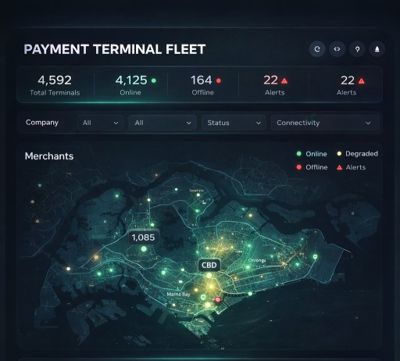
Key Use Cases for Terminal Network Operators
Designed for organizations managing large terminal networks across merchants and stores, providing operational visibility, lifecycle governance, and automated oversight without direct device control.
Fleet-Wide Operational Visibility
Centralized visibility into terminal status and activity based on terminal-reported data and operational updates.
Merchant & Store Provisioning
Onboard merchants, stores, terminals, and users programmatically without manual provisioning overhead.
Help Desk Efficiency
Accelerate issue triage and resolution using centralized terminal context and support tooling.
Serialized Inventory Tracking
Track terminals as serialized assets across procurement, deployment, transfers, and retirement.
Firmware Visibility & Governance
Maintain awareness of reported firmware versions and identify inconsistencies across the terminal fleet.
Operational Reporting & Compliance Support
Automated reporting to support operational oversight, audits, and risk monitoring.
Platform Overview
Production-ready, cloud-native management system designed for daily operational use by management, support teams, and merchants.
The MicroTelecom Terminal Management Platform supports large-scale payment terminal networks with complex organizational structures, high availability requirements, and long-term operational growth—without custom development or re-platforming.
Multi-Tenant Architecture
Secure, cloud-native architecture designed to support multiple enterprises, service providers, and merchant networks within a single platform.
- Logical tenant isolation across enterprise, merchant, store, and terminal hierarchies
- Centralized oversight with delegated control at each organizational level
- Supports service-provider, reseller, and direct-merchant operating models
- Eliminates the need for separate systems as networks expand
Enterprise Scale & Performance
Designed from the ground up to handle large and growing terminal fleets without operational degradation.
- Supports thousands of businesses and tens of thousands of deployed terminals
- Optimized for high read/write activity from monitoring and automation workflows
- Scales horizontally with demand without structural changes
- Suitable for regional, national, and multi-country deployments
Role-Based Access & Operational Security
Granular access controls ensure the right teams have the right visibility—without exposing unnecessary data.
- Role-based permissions for administrators, support agents, and merchants
- Scoped access aligned with enterprise → merchant → store hierarchies
- Separation of operational, administrative, and reporting functions
- Designed to support auditability and compliance requirements
Production Proven & Operationally Mature
This is not a prototype or experimental system.
- Already deployed and in active production use
- Designed to function as a daily system of record
- Built to support real-world support workflows and operational SLAs
- Reduces delivery and operational risk versus custom-built solutions
Designed for Day-to-Day Operations
Unlike reporting-only or configuration-heavy tools, the platform is intended to be used continuously across operational roles. Management teams monitor fleet health and trends, support teams investigate and resolve issues, and merchants access relevant information without requiring support intervention—while automation and reporting reduce manual oversight.
Platform APIs & Automation
Seamless integration with service provider systems—operate at scale without expanding support or operations teams.
The platform includes out-of-the-box APIs to programmatically manage merchants, locations, and terminals, enabling automated provisioning, lifecycle control, and operational reporting across large terminal fleets.
What the APIs Enable
Automate core operational workflows that are typically manual or error-prone at network scale.
- Create and manage enterprises, merchants, stores, and locations programmatically
- Add, remove, reassign, and retire terminals as part of lifecycle operations
- Synchronize device inventory states (in stock, in transit, deployed, retired)
- Trigger operational actions from external systems without human intervention
Integration Targets
Integrate terminal onboarding and inventory reservation with external systems, while operational fulfillment is handled through MTPOS.
- External portals and ordering systems (reserve equipment for shipment to a specific store or location)
- Merchant onboarding workflows (programmatically create stores, gateways, terminals, and users)
- Operational inventory fulfillment in MTPOS (receiving, shipping, transfers, cycle counts, adjustments)
- Outbound updates to external systems (inventory movements and status changes via API or scheduled batch exports)
Security & Governance
APIs are designed for enterprise governance with role-aware access and operational auditability.
- Authenticated API access with scoped permissions aligned to tenant roles
- Supports separation of duties across admin, support, and merchant operations
- Designed to support auditability for security and compliance requirements
- Reduces operational risk by standardizing provisioning and lifecycle changes
Automation & Scheduled Workflows
Built-in automation supports proactive monitoring, compliance, and operational oversight.
- Schedule operational reports for recurring monitoring and compliance needs
- Weekly report: all offline terminals across the network
- Monthly report: terminals inactive for 30+ days for security tracking
- Support rapid exception handling without manual data pulls
Example Operational Automations
Common service provider workflows include automated store creation, bulk terminal assignment during deployments, scheduled exception reporting, and integration with logistics systems to reconcile inventory movements from warehouse to merchant locations. These automations reduce human error, accelerate onboarding, and improve lifecycle traceability at scale.
End-to-End Terminal Inventory Management
Complete lifecycle control of payment terminals using serialized inventory tracking—across procurement, storage, deployment, and retirement.
Unlike traditional inventory systems that track quantities, the platform treats each terminal as a uniquely identified asset. Every terminal is tracked by serial number across all inventory operations, providing full traceability, accountability, and operational control.
Serialized Terminal Lifecycle Control
Each terminal is managed as an individual asset from the moment it enters inventory.
- Unique serial number tracking across all inventory operations
- Full movement history from procurement to deployment and retirement
- Clear ownership and assignment at every stage of the lifecycle
- Eliminates blind spots common in quantity-based inventory systems
Reservation, Fulfillment & Deployment
Support modern deployment workflows without manual coordination.
- Reserve specific terminals via API for external ordering workflows
- Fulfill reservations through MTPOS warehouse and logistics operations
- Deploy terminals to specific merchants and store locations
- Maintain traceability between reservation, shipment, and activation
Transfers, Audits & Inventory Accuracy
Maintain accurate terminal records across distributed environments.
- Serialized transfers between warehouses, stores, and merchants
- Cycle count and inventory audits using web and mobile tools
- Rapid identification of missing, duplicated, or misallocated terminals
- Reduces loss, shrinkage, and operational reconciliation effort
Warranty, Service & Recall Management
Extend serialized tracking beyond deployment into ongoing operations.
- Associate terminals with warranty periods and service history
- Track maintenance, replacements, and returns by serial number
- Rapid identification of affected devices during recalls or incidents
- Improves compliance, support efficiency, and risk mitigation
Operational Impact
By tracking terminals as serialized assets rather than anonymous inventory units, the platform provides unmatched visibility and control. Service providers gain confidence in terminal location, status, and ownership, while reducing loss, improving compliance, and supporting scalable deployment without manual reconciliation.
Operational Visibility & Terminal Status Awareness
Centralized visibility into terminal status and operational state, based on terminal-reported data and operator-managed updates.
The platform provides a consolidated view of terminal status across enterprises, merchants, and stores. Visibility reflects the most recent information reported by terminals that integrate with the platform, combined with real-time operational updates performed by support and operations teams.
Hierarchical Network Visibility
Understand terminal status and distribution across the full organizational hierarchy.
- Network-wide view across enterprise, merchant, store, and terminal levels
- Consistent operational visibility for large, multi-entity environments
- Rapid navigation from aggregated views to individual terminals
- Supports operational oversight without direct device access
Terminal-Reported Status & Firmware Information
Terminal status is based on data actively reported by the terminal software.
- Terminals report firmware version and operational status via secure APIs
- Status reflects the most recent successful communication from the device
- Last-reported timestamp provides context on terminal activity
- No polling or inbound connections to terminals are required
Operator-Managed Operational Status
Support and operations teams maintain accurate operational context.
- Manual and workflow-driven updates to terminal operational state
- Ability to mark terminals as deployed, inactive, under investigation, or retired
- Status changes recorded for traceability and reporting
- Supports operational accuracy even when terminals are offline
Exception Awareness & Operational Signals
Identify potential issues without relying on direct terminal connectivity.
- Highlight terminals that have not reported status within expected timeframes
- Detect inactivity patterns that may require investigation
- Support proactive follow-up by operations and support teams
- Aligns with security and compliance constraints for payment devices
Help Desk & Support Operations
Real-time operational support tooling designed for high-availability, transaction-critical environments.
The platform includes an optional, fully integrated support desk designed to handle terminal-related incidents and operational workflows where traditional ticket-based support alone is insufficient. it enables faster triage, clearer ownership, and real-time collaboration across support teams.
Unified Search & Operational Context
Instantly locate terminals and related operational data.
- Search terminals by serial number, merchant, store, or location
- Access current and historical terminal status in a single view
- Eliminate manual information gathering during live support calls
- Reduce dependency on verbal serial number exchange in retail environments
Real-Time Support Awareness
Support teams operate with live visibility, not delayed signals.
- View last-reported terminal status alongside operational notes
- Rapid identification of offline or misconfigured devices
- Accelerates triage without waiting for ticket escalation
- Supports near real-time response in transaction-critical scenarios
Support Team Coordination & Visibility
Built for continuous, 24/7 operational coverage.
- Live visibility into which support staff are online and handling issues
- Clear tracking of case ownership, handoffs, and shift changes
- Internal communication tools for coordination between support staff
- Reduces operational gaps during handovers and escalations
AI-Assisted Support Intake
Accelerate issue reporting and reduce friction during live incidents.
- Secure AI chat interface integrated directly into the support UI
- Enables structured, real-time issue reporting without lengthy ticket forms
- Particularly effective when merchants are actively serving customers
- Improves accuracy and speed compared to phone-only support flows
Support operations are a modular component of the platform. Customers may adopt the help desk independently or alongside terminal tracking, inventory management, and operational automation. The platform is designed to integrate with existing support processes or operate as a standalone support environment.
Firmware Visibility & Lifecycle Governance
Maintain visibility and governance over terminal firmware versions across the fleet—without direct device control.
The platform tracks firmware information as part of each terminal’s lifecycle record, based on data reported by terminals and operational updates performed by support teams. This enables consistency monitoring, compliance reporting, and informed operational decision-making without initiating connections to payment devices.
Firmware Version Awareness
Track reported firmware versions as part of each terminal’s operational profile.
- Firmware version captured from terminal-reported data when available
- Operational firmware metadata maintained alongside serialized terminal records
- Last-reported firmware information retained for historical reference
- Supports mixed terminal models and vendor ecosystems
Fleet Consistency & Policy Oversight
Identify deviations and inconsistencies without managing firmware distribution.
- Compare firmware versions across merchants, stores, and terminal groups
- Highlight terminals running unexpected or outdated firmware versions
- Support internal governance and vendor coordination processes
- Reduce configuration drift across large deployments
Firmware as Part of the Terminal Lifecycle
Treat firmware information as lifecycle metadata, not a standalone control surface.
- Firmware visibility integrated into serialized terminal lifecycle tracking
- Clear association between device, firmware version, location, and operational state
- Historical records support audits, investigations, and support workflows
- Aligns firmware awareness with inventory, deployment, and retirement processes
Reporting & Compliance Support
Enable reporting and oversight without expanding operational risk.
- Generate reports by firmware version, terminal model, or deployment group
- Support compliance reviews and vendor coordination efforts
- Identify terminals requiring follow-up or remediation
- Reduce manual data collection during audits or incident reviews
Operational Automation & Exception Management
Automated operational insights and exception awareness across terminal networks—without requiring manual oversight.
The platform supports scheduled and on-demand reporting to help operations teams identify issues, risks, and anomalies across terminal fleets. Automation is designed to scale operational awareness without increasing support or administrative burden.
Automated Monitoring & Operational Signals
Surface actionable information without constant manual review.
- Scheduled and on-demand operational reports
- Exception-based identification of terminals requiring attention
- Trend awareness across large, distributed terminal fleets
- Supports proactive operations rather than reactive response
Exception & Risk Detection
Identify potential issues early using operational patterns and reported data.
- Weekly reports identifying offline or non-reporting terminals
- Monthly reports highlighting terminals inactive for extended periods
- Detection of terminals potentially relocated or misused
- Identification of devices operating outside approved geographies
Modular Automation Scope
Automation capabilities are modular and adapt to each customer’s operational model.
- Terminal tracking, monitoring, and reporting operate independently
- No dependency on inventory management workflows
- Customers may integrate with external inventory or logistics systems
- Automation applies consistently regardless of operational scope
Extended Inventory Automation (Optional)
For customers using MTPOS inventory operations, automation extends across the full inventory lifecycle.
- Inventory movement, transfers, receiving, and adjustments
- Cycle count and audit reporting
- Purchase order and replenishment visibility
- Unified reporting across terminals and inventory operations
Customers may adopt the platform solely for terminal visibility, monitoring, reporting, and merchant onboarding, or extend usage to include full inventory operations. The platform is designed to support both models without architectural dependency.
Deployment Models
Choose the deployment model that aligns with your security, compliance, and operational preferences—without feature gaps.
The platform supports both managed and private deployment models using the same core software and capabilities. Customers select the model that best fits their organizational requirements, while retaining full access to platform functionality.
Managed Platform Model
Operate as your own logical entity within a shared platform environment.
- Fastest time-to-value with minimal infrastructure overhead
- No platform infrastructure management required
- Logical tenant isolation across enterprises and merchants
- Ideal for rapid rollout, pilots, and growing networks
- Platform upgrades and maintenance handled centrally
Private Cluster Model
Dedicated deployment within your private cloud environment.
- Full data isolation and infrastructure control
- Supports strict internal security or regulatory requirements
- Deployment aligned with customer-managed cloud policies
- Suitable for regulated environments or enterprise mandates
- Retains full platform functionality and capabilities
Shared Platform Capabilities
Both deployment models use the same core platform and support identical functionality, including terminal visibility, serialized inventory tracking, firmware governance, operational automation, and reporting. There are no feature limitations based on deployment choice.
Customers may choose a deployment model based on current needs and evolve over time as organizational requirements change. The platform is designed to support long-term flexibility without forcing architectural lock-in.
Security & Multi-Tenancy
Secure, role-aware access and tenant isolation designed for multi-entity operational environments.
The platform is built to support service providers, enterprises, and merchant networks operating within shared infrastructure while maintaining strict logical separation, controlled access, and operational auditability.
Role-Based Access Control
Ensure users see and act only on what is relevant to their role and scope.
- Granular role-based permissions for administrators, support teams, and merchants
- Access scoped by enterprise, merchant, store, and terminal hierarchy
- Separation of operational, administrative, and reporting responsibilities
- Reduces risk of unauthorized access or accidental changes
Multi-Tenant Isolation
Support multiple organizations within a shared platform without data overlap.
- Logical tenant isolation across enterprises and merchant hierarchies
- Clear separation of data, users, and operational scope
- Designed to support service-provider and reseller operating models
- Prevents cross-tenant visibility while enabling centralized oversight
Operational Auditability
Maintain traceability across operational and administrative actions.
- Key operational actions recorded for review and investigation
- Supports internal audits, compliance reviews, and incident analysis
- Visibility into changes affecting terminals, inventory, and users
- Reduces reliance on manual tracking or external documentation
Security by Design
Security is embedded into platform architecture and operational workflows.
- No inbound connections initiated to payment terminals
- Terminal interactions rely on authenticated, terminal-initiated communication
- Operational controls designed to align with industry security expectations
- Supports secure scaling without expanding attack surface
Why This Platform
A production-proven platform designed to reduce delivery risk, accelerate adoption, and support long-term operational growth.
Enterprise Platform
Built on a mature, enterprise-grade platform deployed globally to support complex, high-volume operational environments across multiple regions.
Built to Scale
Designed to support growing terminal networks and organizational complexity without re-platforming or architectural redesign.
Operationally Complete
Covers the full operational lifecycle—from onboarding and visibility to governance, automation, and reporting—while allowing customers to adopt only the components they need.
Ready Out of the Box
Reduces implementation time, operational overhead, and long-term maintenance effort compared to building and maintaining a bespoke solution.
Ready to Transform Terminal Management
A production-ready platform for managing terminal fleets today and scaling services tomorrow.