MTPOS Point of Sale & Inventory
Manage checkout, inventory, purchasing, customers, promotions, fulfillment and multi-location retail from a platform designed to work across desktop, tablet, mobile and browser-based environments.
MicroTelecom was established in 2005, but the software experience behind the company reaches back to the 1990s.
From specialized systems for retail and wireless businesses to long-running Tier-1 service-provider deployments and today's broader business software platform, our history has been shaped by understanding how organizations actually operate and building technology around those requirements.
MicroTelecom's roots extend back to custom business software development in New York in the late 1990s.
Before establishing MicroTelecom, its founders developed specialized systems for a range of business environments, including apparel manufacturing and design operations, office products retailers and suppliers, an online vehicle-transport marketplace, and a secure enterprise email client. These solutions addressed operational requirements spanning product design, ordering, accounting, communications, workflow and online transactions.
That experience later extended into the rapidly evolving wireless retail industry. Software developed for pager retailers managed sales, repairs, customer accounts and automated payment reminders sent directly to customers' pagers. As the market shifted from pagers to cellular phones, the software evolved with it into systems for cellular-phone retail operations.
Founded in 2005, MicroTelecom has more than two decades of experience developing business software for retail, telecommunications and complex multi-location operations. From small and midsize businesses to large enterprise organizations, our software has evolved alongside the customers and industries we serve — from early Windows-based retail systems and hosted services to today's cloud-based SaaS platform, integrated enterprise solutions and connected digital commerce.
MicroTelecom was established in New Jersey in 2005 as a software company focused on the increasingly complex needs of cellular retailers and wireless businesses. Building on earlier software and operating experience, its systems addressed point of sale, wholesale, serialized inventory, activation tracking, commissions, customer management, accounting and multi-location operations.
During this period, MicroTelecom expanded its customer base and deployment options, offering both perpetual and subscription-based licensing with customer-managed deployments or MicroTelecom-managed data hosting.
The software also grew beyond individual retail stores to support master agents, wholesale distributors, large store networks and warehouse operations, bringing broader requirements around inventory, distribution, commissions, purchasing and multi-location management.
By 2008, the platform had evolved through multiple generations and the company moved its headquarters to New York as its customer base, organization and product capabilities continued to expand.
MicroTelecom entered into a major distribution and systems-integration agreement with Amdocs, helping bring the platform into Tier-1 service-provider environments. This marked a significant transition toward larger deployments, complex integrations and the operational requirements of major telecommunications organizations.
Every Tier-1 service-provider deployment has remained in production for at least a decade or continues to operate today. Those long production lifecycles have helped shape how MicroTelecom approaches platform stability, compatibility, support and long-term development.
MicroTelecom's enterprise footprint expanded internationally with service-provider deployments in the Asia-Pacific region. Supporting operations across multiple countries introduced additional requirements around regional business processes, integrations, currencies, languages and distributed support.
MicroTelecom expanded its international deployment experience into Latin America, with implementations in Costa Rica and Colombia.
In 2014, the platform also expanded its omnichannel capabilities, connecting customer, sales and service workflows across multiple channels and operating environments.
MicroTelecom expanded its engineering and operational capabilities with a long-standing affiliated team in India. The team became an important part of software development, quality assurance, technical operations and customer services.
MicroTelecom began a major transition from its established Windows application architecture toward a modern web-based platform. The MTPOS app for iPad was introduced during this period, beginning the evolution toward a platform designed to operate across multiple devices and operating environments.
MicroTelecom relocated its U.S. headquarters from New York to Delaware while continuing to expand its distributed engineering and operating organization.
Throughout the COVID-19 pandemic, MicroTelecom continued providing 24/7 customer support while maintaining its contractual service and SLA commitments.
Development and deployment activity also continued during this period, including a major Tier-1 European implementation that entered production while pandemic-related operating restrictions were still affecting organizations around the world.
The next generation of MTPOS expanded across web, iPad, Android and Windows environments, bringing the platform onto a modern shared technology foundation. Customers could now use MTPOS across traditional workstations, browsers, tablets and mobile devices while maintaining consistent business rules, workflows and integration with the broader platform.
In 2021, MicroTelecom began delivering the latest generation of its SaaS platform from Microsoft Azure using Kubernetes-based cloud infrastructure, extending the company's long-standing hosted-services experience into a modern cloud operating environment for the next generation of MTPOS.
After years of solving complex operational requirements in telecom and multi-location retail, MicroTelecom began expanding more broadly into retail and service industries where many of the same challenges exist: transactions, inventory, customers, fulfillment, distributed operations and controlled access to business information.
Ecommerce and service-desk capabilities expanded the platform beyond the physical store, connecting online customers, ordering, fulfillment, customer support and operational workflows with the broader business platform.
In August 2025, MicroTelecom achieved certification to ISO 9001:2015, formally recognizing its quality-management system and commitment to structured processes and continual improvement.
MicroTelecom continued expanding its platform with content management, managed web hosting, subscription management and recurring billing, allowing businesses to connect more of the customer lifecycle through a common technology foundation.
MTPOS grew from support for 15 languages in 2023 to more than 30 languages by 2026, reflecting the platform's continued international growth.
MicroTelecom's information-security management system also achieved certification to ISO/IEC 27001:2022, complementing the ISO 9001 quality-management certification achieved the previous year.
Early MicroTelecom systems were built around the demanding requirements of wireless retailers, distributors and master agents.
Today's MTPOS platform extends that operational foundation across modern Windows, Android, iPhone, iPad and browser-based environments while supporting broader retail, inventory and enterprise workflows.
The interfaces, devices and infrastructure have evolved dramatically. The underlying approach has remained consistent: software should adapt to the operation rather than forcing the operation to adapt to the software.
That long exposure to different operating environments is reflected in the breadth of MTPOS today. Features, workflows and configuration options have accumulated through years of product development, customer feedback and the practical requirements of businesses ranging from smaller retail operations to complex enterprise organizations.
MicroTelecom serves SMB and enterprise customers through dedicated divisions designed around the different ways these organizations adopt, deploy and extend business software. SMB customers generally need a fast, self-service path with extensive configuration, while enterprise organizations may require complex deployment, systems integration and customer-specific development. Both are long-standing parts of our business and both contribute to the platform's continued evolution.
For SMB customers, MTPOS is delivered as a highly configurable SaaS platform designed for rapid adoption and ongoing configuration rather than customer-specific development. Customer requests are actively collected and evaluated alongside our own product initiatives; recurring needs that can benefit the broader customer base help shape the product roadmap.
New customers can register for a self-service free trial and, in many cases, be operational in about five minutes. More than 30 industry-specific configurations combine relevant features, templates and preconfigured settings to give businesses a practical starting point aligned with the way their type of operation works.
MTPOS also does not tie customers to proprietary POS hardware. Businesses can choose hardware appropriate for their operation while using MTPOS across supported Windows, Android, iPhone, iPad and browser-based devices.
Enterprise organizations often require more than a standard deployment. Our Enterprise division supports complex multi-location environments, large implementations, specialized integrations and operating requirements that may extend beyond the general product roadmap.
When customer-specific requirements are operationally critical, time-sensitive or not appropriate for the general roadmap, they can be delivered through formal change-request projects, custom development, systems integration and long-term technical support.
These engagements have repeatedly pushed the platform into demanding environments involving scale, integration, specialized workflows, compatibility and long production lifecycles. Experience gained through enterprise projects also helps inform the platform's continuing evolution when those lessons have broader value.
Registered customers on the MTPOS Max plan and above, including SMB customers, can generate their own API key directly from the platform and connect MTPOS with an existing ecommerce website or other business system using standard APIs. Supported integrations can therefore be implemented without requiring a custom MicroTelecom development project.
Standard API workflows include inventory-level checks, order creation, reservation creation and cancellation, customer creation, customer search and other connected operations. A retailer can, for example, connect its existing web platform to MTPOS to support buy online, pick up in store (BOPIS), even without using the MicroTelecom ecommerce platform.
The founders who established MicroTelecom in 2005 remain actively involved in the company today.
Their continued involvement spans technology, operations and long-term direction, providing continuity as the company and its software have expanded across markets, technologies and customer environments.
That continuity has helped MicroTelecom evolve from specialized cellular-retail software into a global software organization without losing the operational discipline, technical involvement and customer focus established during its earliest years.
MicroTelecom is headquartered in Delaware, with executive management in the United States and teams operating across India and other countries. Together, our global organization supports product development, software engineering, quality assurance, technical operations, managed services and customer operations across multiple time zones.
Corporate headquarters and executive management are based in the United States, alongside product development, software engineering and customer-facing operations.
Teams in India and other countries work alongside our U.S. teams across product development, software engineering, quality assurance, technical operations, managed services and customer support.
Today, MicroTelecom develops a connected software portfolio spanning point of sale, inventory and multi-location operations, ecommerce, managed websites, subscriptions and customer service. Products can be used independently or connected through shared data, workflows and integrations as business requirements grow.
Manage checkout, inventory, purchasing, customers, promotions, fulfillment and multi-location retail from a platform designed to work across desktop, tablet, mobile and browser-based environments.
Support complex multi-location, franchise, dealer and service-provider environments with enterprise deployment, systems integration, customization and long-term technical support.
Build and manage business websites, landing pages, protected content and digital experiences with publishing workflows, permissions, SEO tools and managed hosting.
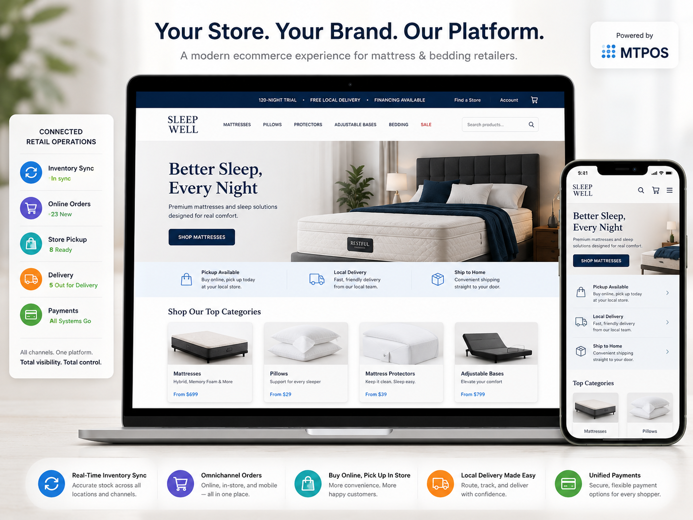
Sell products, services, digital goods, memberships and subscriptions while managing customer accounts, payments, fulfillment, promotions and connected retail inventory.
Manage customer support, internal requests, service history, escalations, knowledge, QA and operational workflows from a dedicated service-management platform.
Start with the software your business needs today. Connect products later when shared inventory, online orders, customer accounts, subscriptions or support history can simplify the way your teams operate.
Long-running systems require more than product features.
MicroTelecom maintains certified quality-management and information-security management systems supporting a structured approach to development, operations, security, service delivery and continual improvement.
Security & ComplianceQuality Management System
Information Security Management System
Explore the software MicroTelecom builds today. For complex enterprise environments, our Enterprise Sales team can discuss specialized integration, deployment and customization requirements.